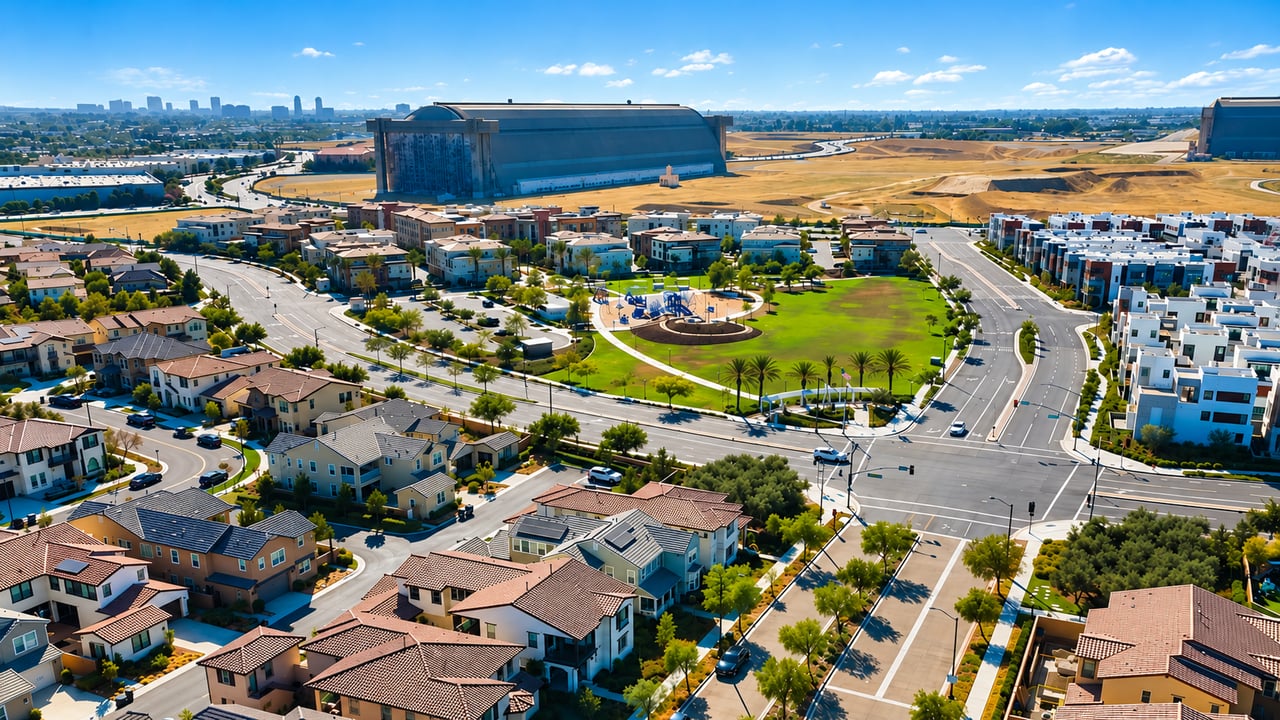
What is a 1942 blimp hangar worth to anyone besides the city that pays to guard it? Tustin will find out over the next nine months. The South Hangar is roughly 180 feet tall, 300 feet wide and 1,000 feet long. The Navy built it for its lighter-than-air program during World War II and still owns it, according to the City of Tustin. Since the North Hangar burned, it is the only one of the base's two hangars left standing.
The city leases and manages the structure and has now asked outside parties to propose what should happen to it. The offering lists no preferred outcome. Preservation, operation, adaptive reuse and redevelopment are all open. The hangar's future will depend on who responds and what they can pay for, more than on any plan drawn up at City Hall.
The city stopped drawing plans and started taking offers
The shift took three council meetings. On June 2, 2026, the City Council received the Tustin Legacy Outreach and Engagement Report. It then told staff to start a competitive offering for the South Hangar and to prepare backup options in case no workable reuse proposal comes in. On July 21, the council authorized staff to prepare and release that offering, covering the hangar and part of the surrounding leased land.
On September 15, the council voted 5–0 to let the City Manager negotiate and sign a listing agreement with CBRE, Inc. to market the site. Council Member Gallagher made the motion and Mayor Pro Tem Schnell seconded it. The minutes authorize the City Manager to negotiate and execute the agreement. They do not show that a signed agreement exists yet.
According to the July staff report, the offering is meant to help the city do six things:
- Find qualified organizations interested in preserving, operating or adaptively reusing the hangar
- Evaluate possible public-private investment
- Test whether proposed concepts work financially and operationally
- Find ways to cut long-term public maintenance and operating costs
- Support future historic preservation where feasible
- Inform the council's eventual decision on the hangar's long-term future
Historic preservation is on that list, but with the qualifier "where feasible." Cutting public costs has no qualifier. The cost estimates explain why.
Four price tags for one building
Page & Turnbull, a historic architecture and preservation consultant, found that the hangar needs life-safety repairs. One hazard it flagged is debris falling from the ceiling. The firm then priced a range of scenarios. Here is what the city's July 2026 report lists, from the current situation up to the most ambitious option:
Scenario | Estimated cost | What it buys |
|---|---|---|
Keep things as they are | More than $1 million a year | 24-hour security, perimeter fencing, lighting, cameras and emergency access around a building that is used only on a limited basis |
Basic structural stabilization | About $22.6 million | Enough work to keep supporting the current airship storage and maintenance |
Rehabilitation | About $203 million | Full repair of the structure |
Broader adaptive reuse | About $271 million | A new kind of use inside the hangar |
The bottom row costs about 12 times the second row. Even the $22.6 million option leaves the hangar doing what it does now, housing airships. The first row also costs more over time. The city added its security measures after the North Hangar fire in November 2023. Staff say those measures have made the site much safer but have not fixed the structural and life-safety problems that limit how the building can be used. Staff also expect the cost of keeping things as they are to keep rising.
So waiting is not free. The city already spends seven figures a year on the hangar, and this offering is meant to find out whether a private partner would take on some of that cost.
What the zoning already allows, and the land deal behind it
The site covers about 32 acres. It is bounded by Moffett Drive to the north, Warner Avenue to the south, Armstrong Avenue to the east and Tustin Ranch Road to the west. It falls in Neighborhood D of the Tustin Legacy Specific Plan and is zoned Mixed-Use Urban. That zoning already allows commercial retail, commercial entertainment, residential, hotel and public recreation uses. A proposal can cover just the hangar or take in nearby land as well. Any use the plan does not allow would need separate council approval, including a Specific Plan amendment if required.
The ownership setup affects every bid. The Navy owns the land, so the city is a tenant offering a sublease. The staff report says that is why California's Surplus Land Act does not apply now. That law covers only land a city owns outright. If Tustin later gains full ownership and wants to sell, extend or sign a new lease, the law would apply at that point. As a result, a bidder can't buy the hangar outright. It can only become a long-term partner on federal land, and its proposal has to make financial sense on those terms.
The North Hangar site is just as open
The open questions extend past the South Hangar. The North Hangar burned on November 7, 2023. The city's local emergency lasted about 950 days and ended in June 2026. State regulators had declared the cleanup of debris and hazardous waste complete before then.
All that remains of the North Hangar is four concrete corner pillars and a damaged slab. They stand on Parcel 18, an 85-acre piece of land the Navy still owns. The Orange County Register reports that the parcel was once supposed to become a county regional park, but the county never secured the funding. In 2021 the city, acting as the Local Reuse Authority, took the park out of the federal reuse plan. City staff say the wider planning effort for the rest of Tustin Legacy is weighing how to balance new development with parks and public space. Ideas so far range from open space, sports fields and trails to playgrounds and even water features.
Neither hangar site has a chosen future. Together they make up about 117 acres of the former base, which closed in 1999.
The calendar from here
The September staff report keeps the timeline the council approved in July:
- By December 2026. The competitive offering is finalized and released.
- First quarter of 2027. Staff evaluate the proposals.
- Second quarter of 2027. Staff bring recommendations on next steps back to the City Council.
The Register's August coverage gave a slightly wider window, from October 2026 to January 2027, for releasing the offering memorandum. In either version, the earliest point at which residents could see a specific proposal in a public agenda report is spring 2027.
Residents have already pushed for a voice. At the annual Local Reuse Authority meeting on August 18, held inside the AMC theater at The District at Tustin Legacy, speakers asked the council about preserving the base's military history, traffic, parking, and whether the South Hangar has enough fire protection to prevent what some called another preventable disaster. Mayor Austin Lumbard said the meeting was part of the city's effort to fold resident feedback into planning. "This is part of that process," he said. The Q2 2027 council item will be the clearest chance for public comment on whatever proposals come in. Agendas are posted on the City of Tustin's meeting portal.
Seeing it before anything changes
The city has fully documented the hangar with 3D models and virtual access, but the July report says those files will go to prospective bidders through a secure document center. No public version has been announced. No public tour program has been announced either, and the site is under 24-hour security behind a perimeter fence.
Here is what is open to the public now:
- Victory Park at Park Avenue and Victory Road. The city's park page lists a lookout mound and a Victory Garden with educational features tied to the hangars.
- The Tustin Area Historical Society. Its museum is listed with free admission and has artifacts, vintage photos, maps and video presentations. The society also posts historical and recent photos of the air station on its blimp hangar history page. Its FAQ page is several years old, so check current hours before you go.
- "Titans of History," the city's 25-minute film about the hangars. The Historical Society links to it from its hangar pages.
The nearer-term change on the ground is the pedestrian and bicycle bridge that will link Tustin Legacy Park across Armstrong Avenue, along with park and infrastructure work in Neighborhood D South. Construction is scheduled to start this month and finish in the first quarter of 2028. That puts the bridge's completion within about a year of the council's decision on the hangar next door.
Whatever the council chooses in 2027 will reshape some of the land closest to Tustin Legacy's homes. If you own nearby and want to understand how a decision on a 32-acre landmark could affect your property and your plans, Cindi Karamzadeh can walk you through it. Request a design-forward market consultation and we'll go over what the open questions at the hangar sites mean for your timing.
This article is general information, not legal, tax or financial advice. Consult a qualified professional about your situation.